Champagne Day Trip from Paris — Winter vs Summer & Month-by-Month Calendar
When is a Champagne day trip from Paris best — winter cellar deep-dives, summer vineyard walks, harvest, vintage release, and crowd patterns by month.
A Champagne day trip from Paris works every month of the year — the Maisons stay open, the chalk cellars hold a constant 10-12°C / 50-54°F regardless of season, and the most-booked tour runs year-round. But the experience shifts dramatically between January and August. In winter you get an indoor, cellar-focused day with no crowds; in summer you get green vineyards, outdoor lunches, and the highest visitor density of the year. Harvest (typically late August through mid-September) is the one window where the working life of the region overlaps with visitors — the most rewarding time to visit, and the hardest to book.
This guide breaks the year into seasonal blocks, explains what changes month by month, and recommends specific windows for specific traveller types.
The fixed parts: what stays the same every month
Before the seasonal differences, the things that do not change:
- Chalk cellars sit at 10-12°C / 50-54°F year-round. A wool layer is essential in every month including July. The temperature is what allows the méthode champenoise to work — slow, steady second fermentation in bottle.
- The major Maisons are open year-round with daily cellar tours; only a handful close for two weeks in January for maintenance.
- The featured day trip runs year-round with 10-11 hour duration, hotel pickup in central Paris around 07:00-07:30, drop-off at Hôtel de Ville around 19:00.
- The tour structure — 1 major Maison + 2 family vineyards + winemaker’s lunch + 8+ tastings — does not vary by season. What changes is what you see on the surface drive between stops, and what is in the lunch glass.
Winter: November-February
Champagne in winter is quiet. Most international visitors come in summer, school-holiday weeks, or for harvest. The other forty-something weeks of the year see significantly lower visitor density at every Maison.
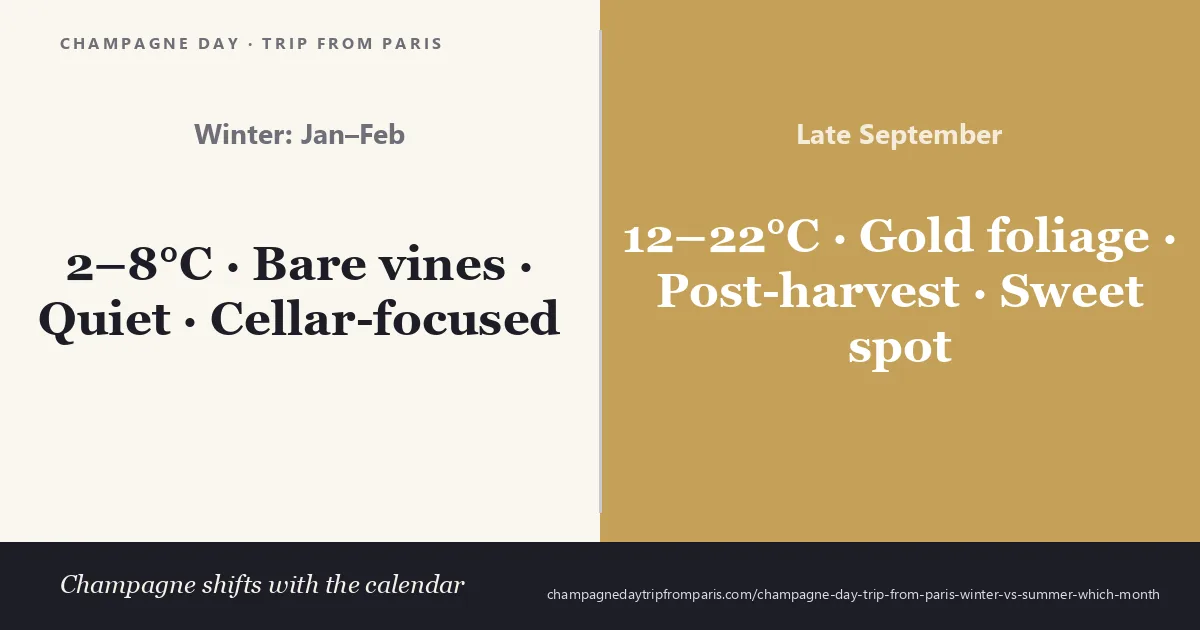
What it looks like: vines are pruned bare; the chalky soil of the Côte des Blancs is visible between rows; mornings are misty and the Marne valley often sits under low cloud. Temperatures range roughly 2-8°C in January, 0-10°C in February, climbing to 4-12°C by March. The drive from Paris through the Champagne countryside is meditative rather than picturesque.
What changes inside the cellars: very little. Winter is the natural time for the second fermentation and lees-ageing to do its work; tours run normally. You will see riddling racks, dégorgement equipment and barrel rooms exactly as they look in July.
Best for: photographers (low light, no crowds, dramatic chalk landscapes), serious Champagne tasters (the smaller group sizes mean longer time with the cellar master), and travellers combining a Paris trip with a Champagne side-day who want the most relaxed pacing.
Avoid if: you want the postcard-vineyard photo, an outdoor lunch in the vines, or the energy of seeing the region in full agricultural swing.
Spring: March-May
The bud-break (débourrement) typically happens in late March or early April, and by May the vines are fully leafed-out. This is the underrated window — the second-best month-by-month value of the year after the September shoulder.
What it looks like: vines emerge from dormancy with the bud-break; by April the vineyards are pale green; by May the canopy is full. Temperatures climb from 4-13°C in April to 9-19°C in May. Rain is common (typically the third- or fourth-wettest months of the year), so a light waterproof is wise.
What changes inside the cellars: new-release tastings of the previous year’s NV brut typically arrive in spring at most houses. If you taste in April-May 2026, you are likely tasting NV cuvées released that quarter — fresher than the same cuvée a year later, but with less bottle age.
Best for: travellers who want the full visual contrast — chalk cellars indoors, green vineyards outdoors — without summer crowd pressure. The May Bank Holiday weeks in France can be busy in central Reims and Épernay; mid-week April is the calmest window.
Summer: June-August
Summer is peak visitor season and peak vineyard photography. The vines are fully canopied, the daylight hours are long, and outdoor lunches are at their best.
What it looks like: lush green vines from horizon to horizon. Daytime temperatures range 15-25°C in June, peaking at 18-28°C in July, and can hit 30°C / 86°F during heat waves above ground — while the cellars stay at 10-12°C. The layer-up rule is at its most extreme: a t-shirt for the vineyard walk, a wool sweater for the cellar.
What changes inside the cellars: crowds. The major Maisons run cellar tours back-to-back through July and August; group sizes are at their largest; English-language slots fill weeks ahead. Day-trip operators run multiple parallel minivans most days.
Best for: travellers who want maximum visual reward — green vines, blue sky, outdoor lunch in the vineyard if weather allows — and who are travelling in summer anyway. Also the most family-friendly window if you have older teens.
Practical tips:
- Book the day trip at least 2 weeks ahead in July-August.
- Confirm whether the lunch is indoor or outdoor at the family vineyard the day before — outdoor seating is weather-dependent.
- Hydration matters. The 8+ tastings spread over 6-7 hours of on-the-ground time are easier on the body in 18°C than in 28°C.
The harvest window: late August to mid-September
The vendanges — the Champagne harvest — is the single most rewarding window to visit the region. It is also the most disrupted. CIVC sets the official harvest start date plot-by-plot each year via the dates d’ouverture des vendanges decree; recent harvests have started progressively earlier as the regional climate has warmed. The 2025 vendanges opened across most of the AOC from around 19-22 August — among the three earliest starts on CIVC record, though not the absolute earliest (the 2020 harvest still holds that title, with most communes opening between 13 and 17 August). Early CIVC and Syndicat Général des Vignerons assessments called the 2025 fruit an exceptional vintage with balanced sugar and acidity, on a marketable yield of around 9,000 kg/ha.
What changes:
- The Maisons and growers are working. Cellars are full of pressing equipment, juice tanks and the smell of fermenting must. The educational value is at its peak — you can see exactly what a “press cuvée” looks like as it comes off the press.
- Daily cellar tours often run on reduced schedules at the major Maisons because the cellar masters are working harvest. Some grower-producers stop cellar tours entirely for two to three weeks.
- Day-trip operators sometimes substitute alternative vineyards if the originally-scheduled family stop is mid-harvest.
- This is the window where you might see hand-harvested fruit being pressed — Champagne is one of the last major wine regions to require hand harvesting by AOC law.
Best for: Champagne enthusiasts who specifically want to see the working region.
Avoid if: you want a predictable, polished tour with all the standard stops. Harvest weeks are messier than the rest of the year.
Booking tip: check directly with the day-trip operator about which week of harvest your booking falls in. Some operators block bookings during the most disruptive days; others welcome them with the caveat that itineraries flex more than usual.
Autumn: late September-October
Once harvest finishes (typically the last week of September in recent years), the region settles into a stunning autumn-colour window. This is the agreed sweet spot among repeat visitors.
What it looks like: the vine leaves turn gold and red across the Côte des Blancs and Montagne de Reims; the harvest is in but the cellars are still humming. Daytime temperatures range 12-22°C in September, 8-16°C in October. Light rain is more common than in summer.
What changes: cellars resume normal tour schedules within a week of harvest end. Group sizes drop sharply once school is back in session. New vintage juice is in tank — at some grower-producers your tasting will include a glass of fermenting vin clair (the still base wine before second fermentation), which you cannot taste in any other window.
Best for: the most-cited sweet-spot answer when serious visitors are asked when to come. Combines summer’s visual reward with winter’s pacing, plus the bonus of seeing the post-harvest cellar.
Month-by-month summary
| Month | Visit feel | Crowd density | Vineyard look | Cellar temp | Special note |
|---|---|---|---|---|---|
| January | Quiet, cold, intimate | Lowest | Bare vines, chalk visible | 10-12°C | A few Maisons close 1-2 weeks for maintenance |
| February | Quiet, cold | Very low | Bare vines | 10-12°C | Pruning underway in plots |
| March | Late winter, transitional | Low | Bud-break starts late month | 10-12°C | Weather variable |
| April | Spring | Low-medium | Pale green, growing | 10-12°C | New-release NV typically arrives |
| May | Late spring | Medium | Full canopy by month-end | 10-12°C | French bank holidays = local crowds |
| June | Early summer | Medium-high | Lush green | 10-12°C | Best balance — green vines, manageable crowds |
| July | Peak summer | High | Lush green | 10-12°C | Heat waves possible; book 2+ weeks ahead |
| August | Peak summer | High | Lush, sometimes drought-stressed | 10-12°C | Late August = harvest start |
| September (early) | Harvest tail | High at growers | Working harvest | 10-12°C | Most 2020s harvests now start late August, not September |
| September (late) | Post-harvest | Medium | Turning gold | 10-12°C | The sweet-spot window |
| October | Autumn | Low-medium | Gold and red | 10-12°C | Vin clair tastings possible |
| November | Quiet autumn | Low | Bare vines returning | 10-12°C | Calm pacing |
| December | Quiet, holiday-adjacent | Low except holiday weeks | Bare vines | 10-12°C | Christmas-week tasting menus at some Maisons |
When to book each window
| Traveller type | Recommended window | Why |
|---|---|---|
| First-time Paris-and-Champagne combined trip | Late September - early October | Sweet-spot weather + post-harvest cellar + manageable crowds |
| Champagne enthusiast / hardcore taster | Early September | Working harvest = highest educational value |
| Photographer | Late October OR late January | Autumn colour OR chalk + mist landscapes |
| Family with older teens | June-July | Maximum daylight + green vines + outdoor lunch potential |
| Budget-conscious / quiet pace | February-March OR November | Lowest crowds, sometimes-promotional day-trip pricing |
| Couples / quiet luxury | Late September | Calm pacing + visually peak vineyards |
What does not change between seasons
A reminder: the most-booked Champagne day trip from Paris does the same itinerary year-round — hotel pickup in central Paris, one major Maison cellar tour, two family vineyards, 8+ tastings, winemaker’s-table lunch paired with three Champagnes. The what is constant; the how it feels moves with the calendar.
If you are planning the trip and not sure which week to pick, the late-September window is the lowest-regret answer for most travellers. If you specifically want to see harvest, target the second or third week of September. If you only have winter dates, do not skip the trip — winter cellars with a small minivan group is a genuinely memorable experience that summer crowds dilute.
Further reading
- The RM vs NM guide explains why the family-vineyard half of the day is what changes most between seasons (the major-Maison cellar visit is identical year-round).
- The Maison-by-category guide covers which houses make the most sense in each season.
- The Paris-to-Champagne logistics guide covers transport options in different weather.
Ready to Book?
The Champagne Day Trip from Paris with 8 Tastings & Lunch (from $379, 4.8/5 from 1,601 guests, free cancellation up to 24h) runs every month of the year with the same 10-11 hour structure. Hotel pickup in central Paris around 07:00-07:30, drop-off at Hôtel de Ville around 19:00, English-speaking wine guide, A/C minivan with max 8 guests. Layer up regardless of season — the cellars are always 10-12°C.
Champagne in a Single Day — Paris Pickup, 8+ Tastings, Real Lunch
Join 1,601+ travellers who rated this Champagne day trip 4.8/5. Hotel pickup in Paris, one major Maison, two family vineyards, 8+ tastings, a French winemaker's lunch — all in a comfortable A/C minivan with an English-speaking wine guide. Free cancellation up to 24h.
Check Availability & Book