Récoltant-Manipulant vs Négociant-Maison: Reading Champagne Labels Like a Grower
RM vs NM Champagne explained — what the two-letter codes on the back label mean, why grower-Champagne tastes different, and what to ask on a vineyard visit.
If you have ever turned a bottle of Champagne around and squinted at the tiny two-letter code next to the producer’s address, you have already met the most useful piece of information on the label. RM stands for récoltant-manipulant — a grower who makes Champagne only from grapes they farm themselves. NM stands for négociant-manipulant — a house that buys grapes (or finished wine) from many growers and blends a consistent house style across hundreds of plots.
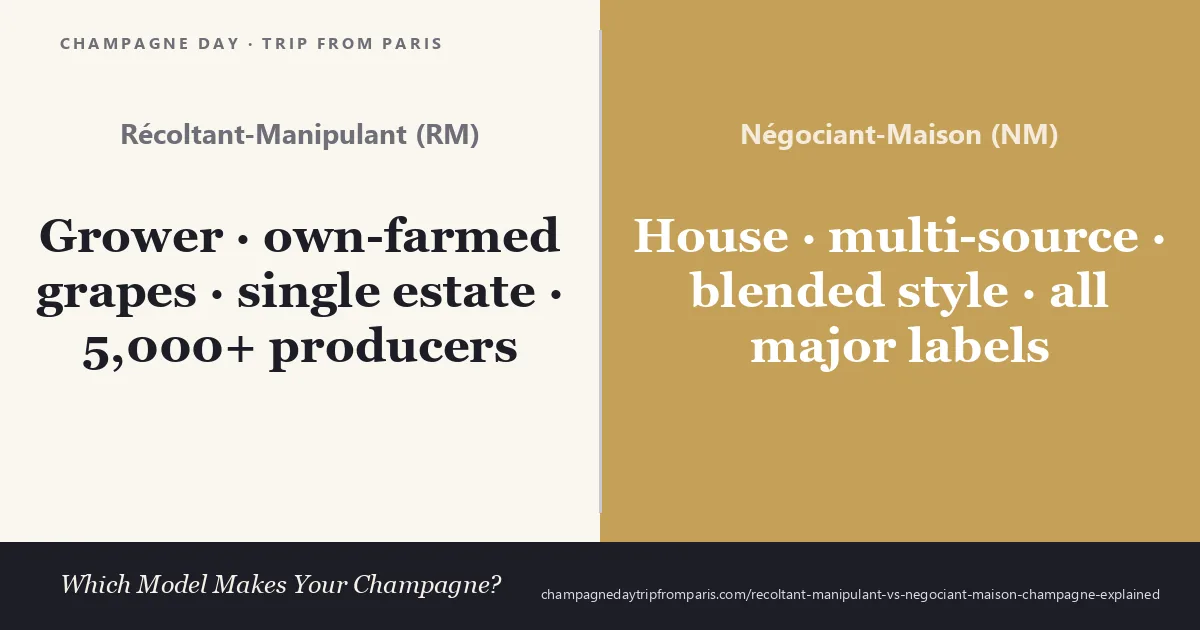
It is the single distinction that explains why the Champagne day trip from Paris pairs one major Maison with two small family vineyards: the contrast between those two production models is the whole point of a region tour. A Mumm or Veuve Clicquot cellar shows you how a négociant assembles a “house style” from across the Champagne AOC; the family-grower stops show you what one specific terroir, in one specific village, in the hands of one specific family, actually tastes like.
This guide walks through every code you can find on a Champagne label, why grower-Champagne occupies a different shelf from grandes marques in serious wine shops, and how to use what you have learned on the cellar visit. If you only have time to remember two things before you board the minivan tomorrow morning, remember this: RM = grower, NM = house, and almost every bottle you have ever bought is NM.
The seven codes on a Champagne back label
Every bottle of Champagne sold legally inside the AOC must carry a producer code — two letters next to the matricule (a string starting with a département number) printed in tiny type near the producer’s address. The CIVC (Comité Interprofessionnel du Vin de Champagne) defines seven of them.
| Code | French term | What it means | Approximate share of AOC |
|---|---|---|---|
| NM | Négociant-manipulant | Buys grapes / juice / wine from many growers; blends and bottles under their own house style. Most grandes marques. | Roughly 390-410 houses (CIVC 2024) — every major brand sits here |
| RM | Récoltant-manipulant | Grower who makes Champagne only from grapes they grew themselves on their own plots. | Approximately 2,000-2,100 producers (CIVC 2024) — by far the largest category by producer count |
| CM | Coopérative de manipulation | A grower cooperative that vinifies and bottles Champagne from members’ fruit under a cooperative brand. | Large by volume; Nicolas Feuillatte is the best-known example |
| RC | Récoltant-coopérateur | A grower who sends their fruit to a cooperative but sells the finished Champagne under their own label. | Niche |
| SR | Société de récoltants | A family-grower partnership (siblings, etc.) pooling vineyard and equipment. | Niche |
| ND | Négociant-distributeur | Buys finished, bottled wine and applies their own label. | Rare on serious wine shelves |
| MA | Marque d’acheteur | “Buyer’s brand” — a supermarket or restaurant private label, made by someone else. | Common in supermarket aisles |
You will almost certainly walk into a major Maison on the first cellar visit (NM) and then into two RM or CM producers in the afternoon. That is by design — your guide is showing you the two ends of the spectrum.
Why “grower-Champagne” became a movement
For most of the twentieth century, Champagne was synonymous with the grandes marques: Moët, Veuve Clicquot, Mumm, Pommery, Bollinger, Krug. Growers across the region sold their grapes to the houses on long-term contracts and used the cash to maintain their plots. The houses then blended across villages, vintages and grape varieties to produce a consistent NV (non-vintage) brut that tasted the same year after year.
From the early 1980s onward, that began to shift. A first wave of growers — Anselme Selosse in Avize (who took over the family domaine around 1980 and converted to certified biodynamic practice in 1996), Pierre Péters in Le Mesnil-sur-Oger, and Egly-Ouriet in Ambonnay (Francis Egly took the reins around 1982) — started keeping their best grapes back from the houses and making Champagne under their own labels. American sommeliers championed them through the 1990s and 2000s; the category had a name in New York wine bars long before it had one in France: grower-Champagne.
The economic story is simpler than the wine story. A négociant house’s job is to absorb vintage variation across hundreds of plots so its NV brut tastes identical every year. A grower’s job is the opposite — to express one specific plot in one specific year. The first model wants consistency; the second wants character.
What it actually means in the glass
On the Champagne day trip from Paris, the AM cellar visit and the PM family-vineyard tastings are designed to make this contrast obvious in the glass. Here is what to pay attention to.
At the major Maison (NM):
- The NV brut on offer will taste exactly like the one on a shop shelf in Paris, London or New York. That is the entire commercial promise.
- The cellar tour focuses on the méthode champenoise — the second fermentation, riddling, dégorgement. The educational story is how Champagne is made.
- The blending is the craft: tens of base wines from different villages assembled into one house style.
At the family-grower (RM):
- The wines will taste of somewhere. A chalk-driven Côte des Blancs Blanc de Blancs has a lean, mineral cut that is hard to mistake. A Pinot-Meunier-dominant wine from the Vallée de la Marne will feel rounder, riper, more orchard-fruit. A Montagne de Reims Pinot Noir base will give weight and red-fruit lift.
- The tasting focus is the vineyard, not the cellar. You will hear specific plot names, soil-depth measurements, the year a particular parcel was replanted.
- The annual production might be 20,000 to 80,000 bottles total — versus an estimated ≈28-30 million bottles a year across the entire Moët & Chandon house portfolio.
This is why the two-vineyard half of the day matters even if you came mostly to see Moët or Veuve Clicquot. You are tasting wines that almost never leave the region, made by families whose name is on the label and the gate.
How to read a Champagne label in the cellar
Pick up a bottle in the tasting room and look for these, in order:
- The big front-label name. Brand identity. Tells you nothing about who actually grew the grapes.
- “Champagne” on the label. This is legally protected — only sparkling wine from the delimited Champagne AOC (set in 1927, formalised in the AOC system in 1936) can use the word.
- The village name (e.g. “Le Mesnil-sur-Oger”, “Aÿ”, “Bouzy”) — often listed if the wine is single-village.
- Grape composition. Blanc de Blancs = 100% Chardonnay. Blanc de Noirs = 100% Pinot Noir and/or Pinot Meunier. Most blends are not labelled — Champagne is by tradition opaque about exact percentages.
- The dosage indication. Brut Nature / Pas Dosé (0-3 g/L sugar), Extra Brut (0-6), Brut (0-12), Extra-Dry (12-17), Sec (17-32), Demi-Sec (32-50), Doux (50+).
- The producer code — the two letters near the producer’s address. RM, NM, CM, etc.
- The vintage, if it is a vintage Champagne. Most Champagne is NV, blended across years; vintage is declared only in exceptional years and carries a higher minimum ageing requirement.
Non-vintage Champagne must spend at least 12 months on lees within a total minimum 15 months between tirage (the second fermentation that starts in bottle) and release. Vintage Champagne carries a 3-year (36-month) total minimum from tirage to release — and in practice almost every vintage cuvée spends the entire window on lees. Many grower-producers go far beyond the minimum — 48, 60, even 72 months on lees — because long lees-ageing is one of the easiest ways to add complexity without buying more land.
Questions to ask in the cellar
You are paying for an expert wine guide and direct access to producers most travellers never meet. Use them. Five questions that consistently get you genuinely interesting answers:
- “What’s the assemblage of this cuvée?” At an NM you get a blending lesson; at an RM you get a vineyard lesson. Both are useful.
- “What was the harvest date this year?” Champagne harvest has shifted progressively earlier as the regional climate has warmed — the 2025 vendanges opened plot-by-plot from around 19-22 August, among the three earliest starts CIVC has recorded (2020 still holds the absolute record at 13-17 August). Growers track this to the day.
- “How long was this wine on lees?” Tells you how the house prioritises ageing complexity over throughput.
- “Where exactly is this plot?” At a grower this opens up the whole village-and-soil conversation; at an NM you will usually get a polite “we source across the region”.
- “What’s the dosage?” Grower-Champagne has trended toward lower dosage over the past 15 years. Sub-6 g/L is now common; some growers ship at zero.
When grower-Champagne is not the answer
This guide is written from inside a day-trip that puts you in two grower cellars. The framing is therefore enthusiastic. But grower-Champagne is not always the right choice.
- For a wedding or a big party, a recognisable grande marque label still does work that an unfamiliar grower name cannot. Brand recognition is a feature, not a flaw.
- For absolute year-to-year consistency, the négociant model is purpose-built and a single grower simply cannot match it. A bottle of Veuve Clicquot Yellow Label in 2026 tastes (deliberately) almost identical to one in 2016.
- For pure shelf availability, NM dominates international distribution. RM growers often ship only a few thousand bottles to any given export market and run out before the end of the year.
The right answer is usually both. The grandes marques’ job is to be a known quantity in a wine list anywhere on earth; the growers’ job is to be a specific quantity in one specific place. Drinking widely from both is what a serious Champagne education actually looks like.
What this means for your day trip
The two-Maison + two-vineyard structure of the day trip from Paris is not arbitrary. It is the most efficient way to taste both halves of the Champagne story in a single ten- to eleven-hour day. The grandes marques get you the méthode champenoise, the chalk cellars and the history; the RM growers get you the soil, the village, the specific family making the wine.
If you want to extend the education, the Maison-by-category guide breaks down which grandes marques to prioritise if you have the choice, and the winter vs summer guide covers when each style of producer is most rewarding to visit. For Paris-departure logistics — pickup vs TGV-to-Reims vs renting a car — see the day-trip logistics guide.
Ready to Book?
The Champagne Day Trip from Paris with 8 Tastings & Lunch (from $379, 4.8/5 from 1,601 guests, free cancellation up to 24h) is built around exactly this NM-plus-RM contrast: one grande marque cellar tour, two family-grower visits, and a winemaker’s-table lunch where you will taste at least three of that grower’s own Champagnes back-to-back. Hotel pickup in central Paris, drop-off at Hôtel de Ville, English-speaking wine guide, A/C minivan with max 8 guests.
Champagne in a Single Day — Paris Pickup, 8+ Tastings, Real Lunch
Join 1,601+ travellers who rated this Champagne day trip 4.8/5. Hotel pickup in Paris, one major Maison, two family vineyards, 8+ tastings, a French winemaker's lunch — all in a comfortable A/C minivan with an English-speaking wine guide. Free cancellation up to 24h.
Check Availability & Book